


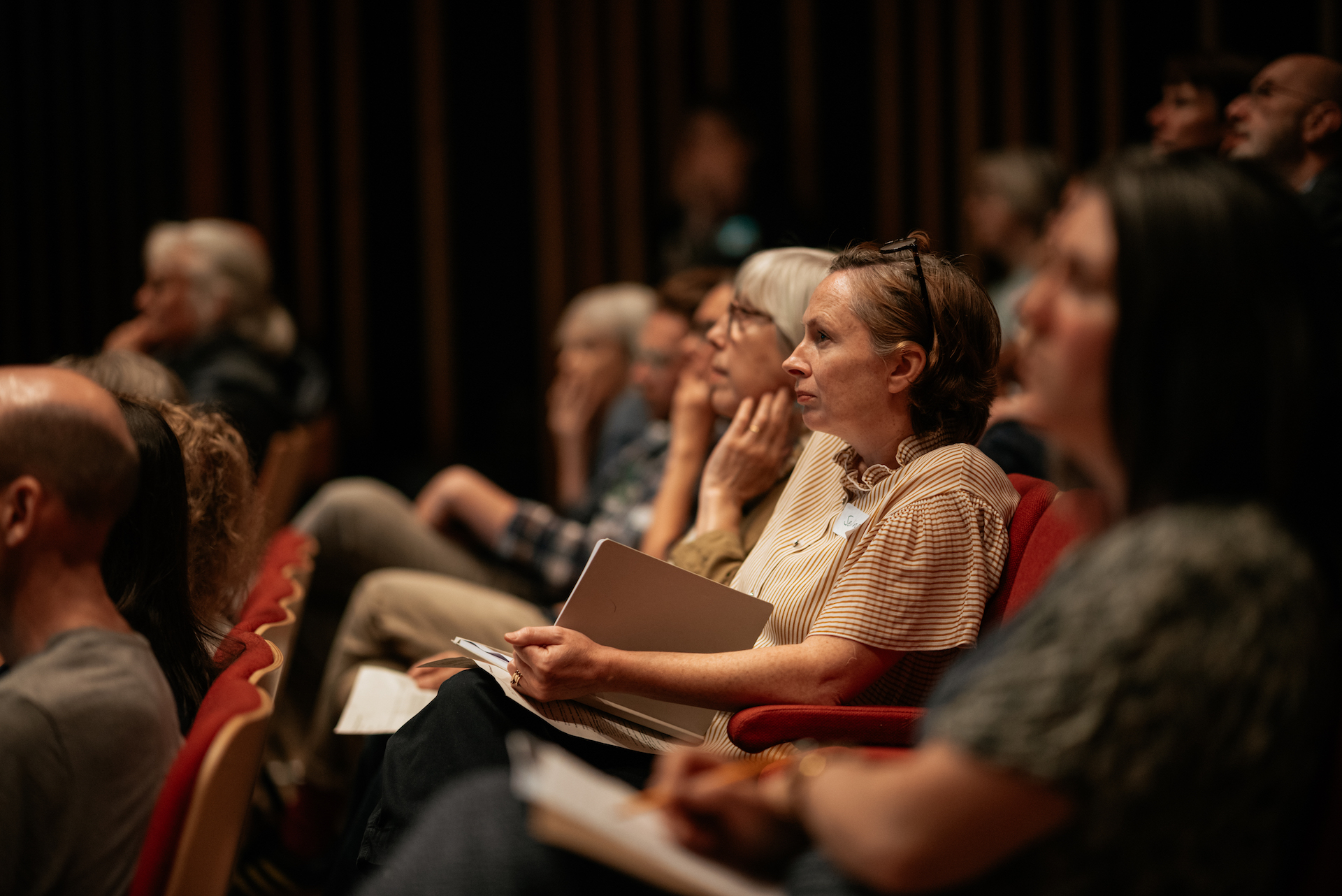
‘And at the moment the world really needs us to think a lot bigger and much more consequential. So we have to argue our work is essential for thinking about things in new ways. Because so much thinking is kind of limited in boxes, and the holistic thinking that artists do and the critical thinking that artists do is incredibly important right now.’
– Lise Autogena speaking at the ‘An Unremarkable Wood’ Symposium in partnership with York St. John University
In June 2025, Chrysalis Arts Development, in partnership with York St. John University brought together artists, ecologists and academics at the 'An Unremarkable Wood' Symposium.
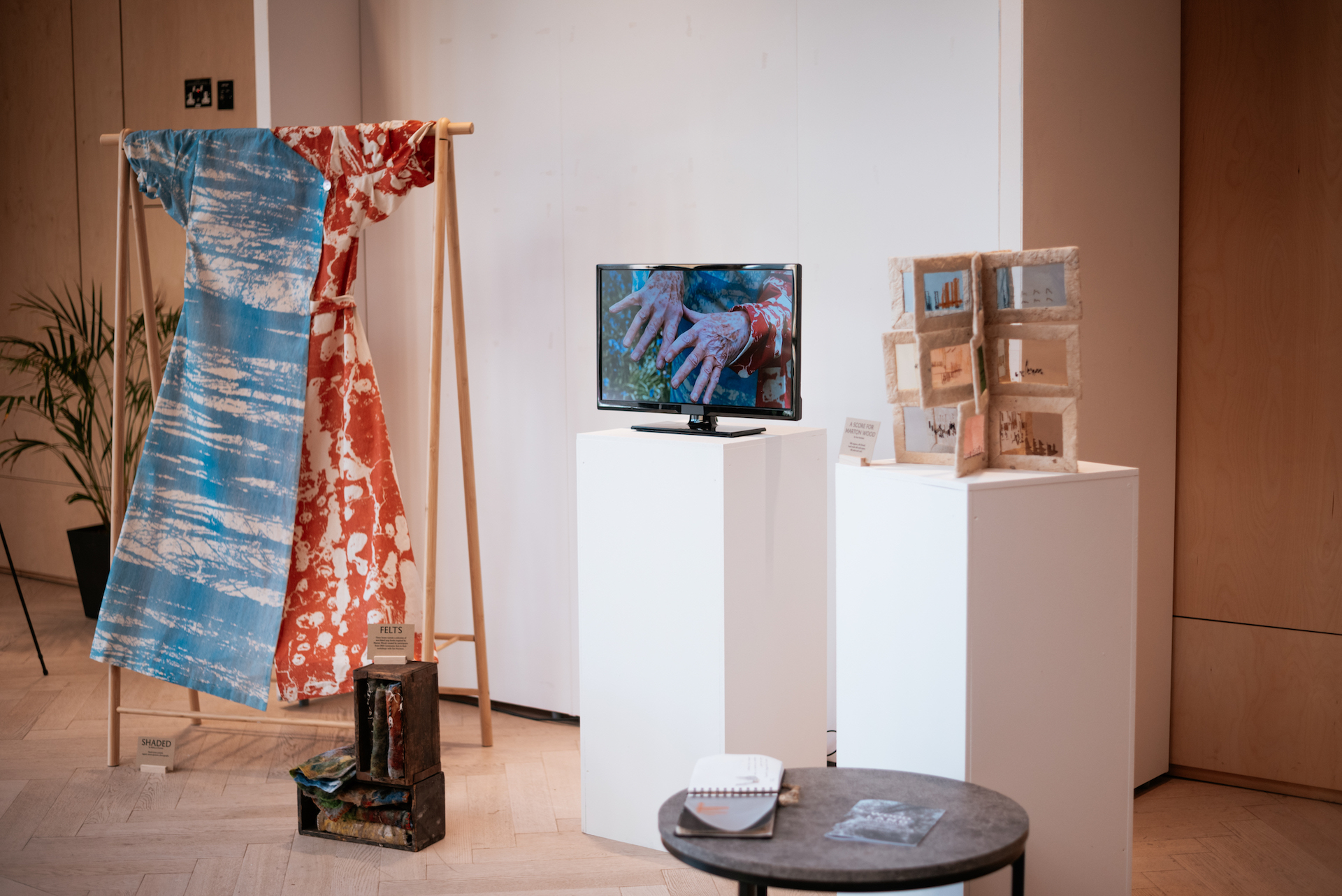
The day combined presentations, panel discussions and breakout sessions to explore the creative relationships and processes that can reset connections with place and nature. YSJ greatly exceeded their in-kind contribution by allowing Chrysalis to use the whole of their new Creative Centre, installations, practical workshops, academic presentations and discussions alongside the main event.
An in-person event, the symposium provided UK based artists with access to talks and discussions by leading international practitioners. Our Keynote speaker, the Danish Artist Lise Autogena, works extensively in Denmark and Greenland. Live streamed from Canada, Eric Moschopedis spoke and took questions as one half of the international duo Mia and Eric. The academic presenters included USA based PlantBot Genetics via live stream. Artists and the ecologist commissioned for the Mapping Marton Wood project presented, as well as participants from Orb Arts.
The audience at the symposium was predominantly made up of artists but also included academics, educators, students, local authority officers and environmental organisations. Most attendees were from the North of England, with some traveling from Ireland, London and Norfolk.
‘Really good, really good. I think it’s the breadth of the speakers, it’s been fascinating.’ – Audience Member
'Today reminded me I am part of a community of artists that are all concerned with the same values and experience the same pressures on our creative time.' – Audience Member
We've gathered together some of the most impactful moments from the day in video format. There is a short highlights video, as well as a fuller feature video. You'll also find quotes and thoughts pulled out below.
Watch
Feature Highlights Video
Short Highlights Video
Read
Lise Autogena on her project in Narsaaq, Greeland and smallness
‘All of this works in operating as visualising something. The house itself for me is my visual output, I’m interested in the smallness of it, and what the scaling of things is interesting. how you scale-something from very local to very global, and something from very small to very big. So i’m trying to use this idea of this small place as a model that connects with other small communities around the world.'
‘A very small location as a platform that can generate, even despite being very small and in a very remote part of the world, a lot of impact through the idea of it being there…. And to bring artists, and to use arts and culture and science to help develop more resilience in this community.’
Lise Autogena on thinking big as an artist
'There’s no limits in how we can work as artists and we need to think much bigger, and we need the world to help us think bigger. Because we are often working in very limited context that doesn’t provide a lot of inspiration for thinking much much bigger. And at the moment the wold really needs us to think a lot bigger and much more consequential. So we have to argue our work is essential for thinking about things in new ways. Because so much thinking is kind of limited in boxes. And the holistic thinking that artists do and the critical thinking that artists do is incredibly important right now.’
Rob Mackay on collaborating with Ecologist Simon Pickles
‘I’m a sound artist and composer. I’m used to exploring places and understanding them through sound. But really through this collaboration I feel that Simon’s knowledge and ways of investigating have really influenced my own practice and certainly my own understanding and ways of knowing. I really feel like I’ve been able to discover that remarkable within the unremarkable of the wood itself’
Simon Pickles on why Marton Wood is both unremarkable and remarkable
'So we’ve kind of got a story coming together around this structure [at Marton Wood]. This unremarkable wood was remarkable in that its structure told a story.'
Simon Pickles on working with artists as an ecologist
But also, I thought that what you did was very different. I thought what you did and what I did was very different. But what I’ve come to understand is that the artists that I’ve met they undergo training, they become experts in a number of mythologies, they apply those methodologies to the world, and they present the results of that inquiry to the world. There is fundamentally very little difference in process between what you do, and what I do, and I think that allows for quite a comfortable – well it allows me to be a co-creator along with artists in quite an interesting way.’
Rob Mackay on bringing art and science together
'And it’s interesting what you’re saying on art and science. Along time ago my joint degree was actually in Geology and Music and Keele university. So I guess for a long time I’ve not really seen much of distinction in terms of the arts and the sciences. There’s different sort of lenses to investigate things through.'
Eric Moschopedis of Mia & Eric on working with woodlands
‘They are cultivated landscapes, deeply entangled with human history, policy, and world view. From the outset, we were not only interested in the hyper local, we wanted to know ‘How do small forests reflect global dynamics Like climate crisis, deforestation, colonial botany and extractive governments. What do these woods teach us about responsibility and possibility?’'
Eric Moschopedis of Mia & Eric on their ways of working
Our methodology is best described as ‘artful research’ It’s a practice grounded in inquiry, not outcome, we don’t begin with a projective please complete, we begin with curiosity, and we let relationships, patterns and context shape the form of the work. In each site, we asked the same broad questions, what is the history of this place, how has it been used, industrially, politically, ecology, recreationally, what forces have shaped it? What does it remember? How is it hacking? '
‘The artistic outcomes are not the point of entry. They are a way of feeding back we have we’ve learned, of continuing the conversations, of honouring those relationships’
‘We draw inspiration from thinkers who help us stay with complexity, rather than seeking easy answers’ This includes perspectives from critical disability and neurodivergents...Which asks us to rethink what counts as intelligence, as value, as voice. These fields help us avoid default logics. What is measurable, legible, dominate. And iInvites us to explore other grammars. Movement, intuition, rhythm and care.’
‘We often talk about tree-time in our practice. A non-linear temporality rooted in ecological processes rather than human urgency.’
Laura Harrington on working together
‘Artists and scientists, rather than thinking, they are going to give me information and I’m going to give them information. Where can you find the shared endeavour?’
Orb Arts Panel
‘It’s nature to me that I’m drawn to, that I want to connect with, that I always want to spend time with. So being told there was a group that was going to spend every Friday going into a piece of woodland, and what was a very private space, and a very safe space, that was initially what jumped out at my straight away, and I was like ‘yes, of course I want to do this. But equally the creative side…’
‘It’s so lovely to bring so many different types of people together. I learned so much from the ecology, data side of stuff, that’s not what I would naturally engage with. I’m much more of an intuitive, holistic kind of person. So then to be met with learning stuff I had no idea about birds or ecological processes going on, to me that wasn’t separate to my beliefs or connections, it actually enhanced them and made me understand deeper and I wouldn’t have had that opportunity without this project.’
Audience Thoughts
'Thank you! The programme was varied and introduced me to new practitioners and approaches. I now want another reading list.'
'Honest wonderful discussion from orb arts. The enthusiasm and genuine feeling among the group was truly lovely.'
'Excellent event. Great programme, venue, lunch, loved the sound walk. Amazing presenters Thanks!'


-01.png)


